


Revolutionary Photodetector for LiDAR Applications
Avalantra introduces a next-generation HD-SiPM featuring ultra-high microcell density, engineered for long-range, high-resolution automotive LiDAR and other advanced pulsed sensing applications
LiDAR

Automotive
Industrial AGV
Topography

Bulk Volume Measurement
FSOC
Space-Based

Ground-Based
BioMed
Tomography
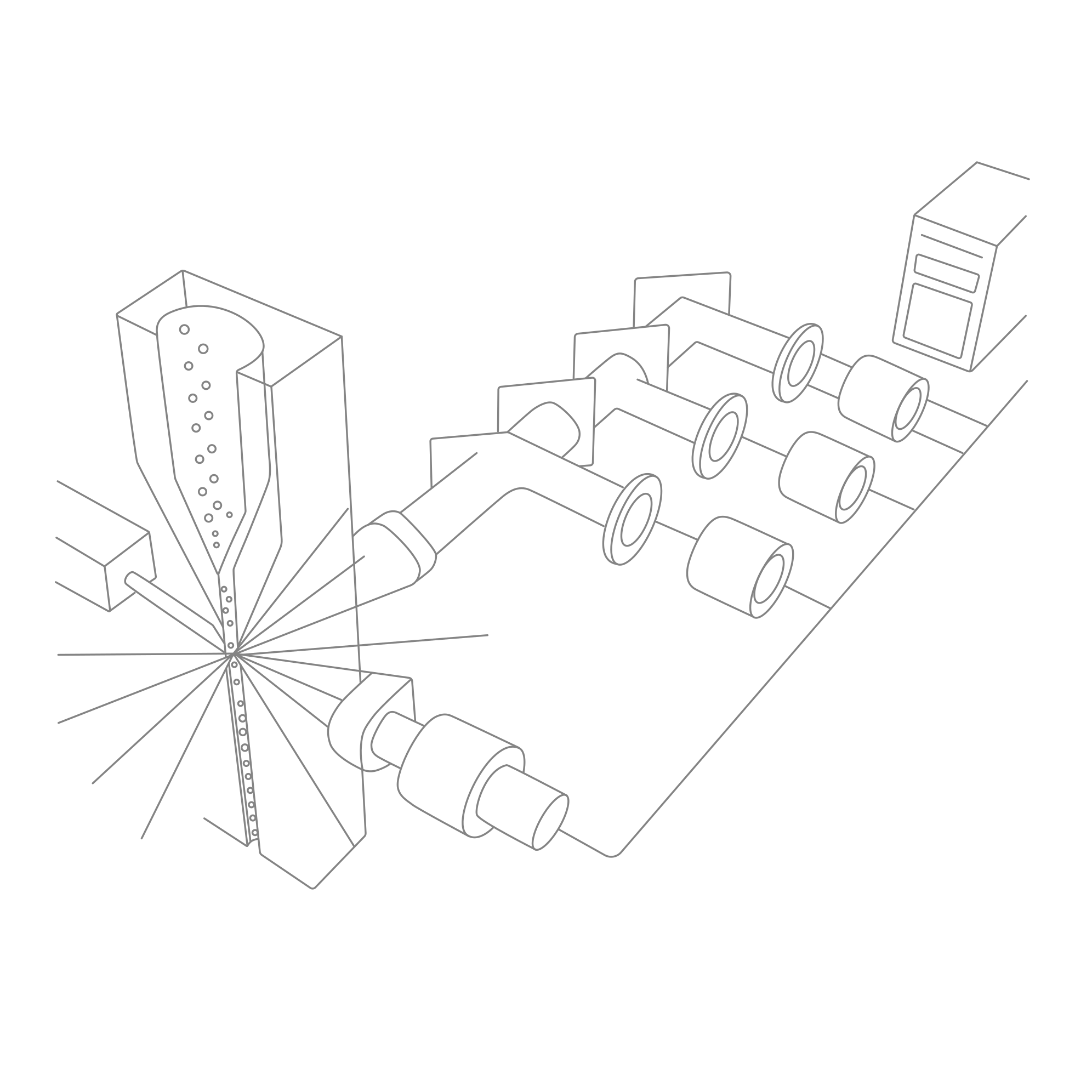
Flow Cytometry
Applications
Detailed parameters are available in the preliminary datasheets
Key Specifications
Parameter
Gen 0.1 / 2026
Gen 1.0 (BSI) / 2027–2028
Unit
Microcell pitch (honeycomb pattern)
≤ 5
≤ 4
µm
Fill Factor
96
100
%
Peak Sensitivity Wavelength
650
650
nm
Photon Detection Efficiency
> 30 @ 650 nm
> 15 @ 905 nm
> 15 @ 905 nm
> 45 @ 650 nm
> 30 @ 905 nm
> 30 @ 905 nm
%
Operating Voltage
65–70
65–70
V
Crosstalk Probability
< 1
< 1
%
Afterpulsing Probability
< 1
< 1
%
Products
Single-Element HD-SiPM
The Avalantra single-element silicon photomultiplier (HD-SiPM) features an ultra-high microcell density, combining high photon detection efficiency with a wide dynamic range. This makes it well suited for rangefinders, mechanical LiDARs, and other pulsed sensing applications.
The single-element HD-SiPM is primarily intended for evaluating Avalantra’s technology. It has a round photosensitive area with available diameters of 100, 250, 500, and 1000 µm, and will be offered in TO-5 or LCC-8 packages.
The single-element HD-SiPM is primarily intended for evaluating Avalantra’s technology. It has a round photosensitive area with available diameters of 100, 250, 500, and 1000 µm, and will be offered in TO-5 or LCC-8 packages.

Download specification
16-Element HD-SiPM Linear Array
The Avalantra 16-element HD-SiPM linear array integrates 16 elements on a single die with a pitch of 530 µm. Each element is implemented as an independent HD-SiPM with ultra-high microcell density. Arrays can be seamlessly tiled in a row with minimal gap to form 32-, 48-, or 64-element assemblies, making them ideally suited for true solid-state 2D LiDAR and mechanical 3D LiDAR systems.
The 16-element HD-SiPM linear array is primarily intended to demonstrate Avalantra’s multi-element capabilities. Each element features a rectangular photosensitive area, available in sizes of 470×1000 µm and 470×170 µm.
The 16-element HD-SiPM linear array is primarily intended to demonstrate Avalantra’s multi-element capabilities. Each element features a rectangular photosensitive area, available in sizes of 470×1000 µm and 470×170 µm.
Download specification
32-Element HD-SiPM Linear Array
The Avalantra 32-element HD-SiPM linear array is a flagship product that integrates 32 elements on a single die with a pitch of 265 µm. Each element is implemented as an independent HD-SiPM with ultra-high microcell density. Arrays can be seamlessly tiled in a row with minimal gap to form 64-, 96-, or 128-element assemblies, making them ideally suited for high-resolution true solid-state 2D LiDAR and mechanical 3D LiDAR systems.
The 32-element HD-SiPM linear array is planned to be offered as a system-in-package together with an ASIC that converts the analog signal to digital. Each element features a rectangular photosensitive area with dimensions of 210×400 µm.
The 32-element HD-SiPM linear array is planned to be offered as a system-in-package together with an ASIC that converts the analog signal to digital. Each element features a rectangular photosensitive area with dimensions of 210×400 µm.
Download specification
Can’t find a suitable solution among our standard products?
Customize your HD-SiPM with Avalantra

Avalantra HD-SiPM

Moderate operating voltage 65–70 V
Optimized gain ~ 10⁴
Good thermal stability
Wide dynamic range
Negligible crosstalk
Multi-element capability

Conventional SiPM / SPAD
Moderate operating voltage 30–40 V
High gain ~ 10⁵–10⁶
Good thermal stability

Limited dynamic range
High crosstalk probability

APD
Good dynamic range
High photon detection efficiency
Low gain ~ 10²
High operating voltage ~ 200 V
Poor thermal stability
Limited multi-element capability
Comparison with Existing Solutions
How True Solid-State Time-of-Flight 3D LiDAR Works
Avalantra HD-SiPM technology makes it possible to design compact and cost-effective true solid-state 3D LiDAR systems, achieving ranges over 250 m under 100 klux background illumination with 10% object reflectivity
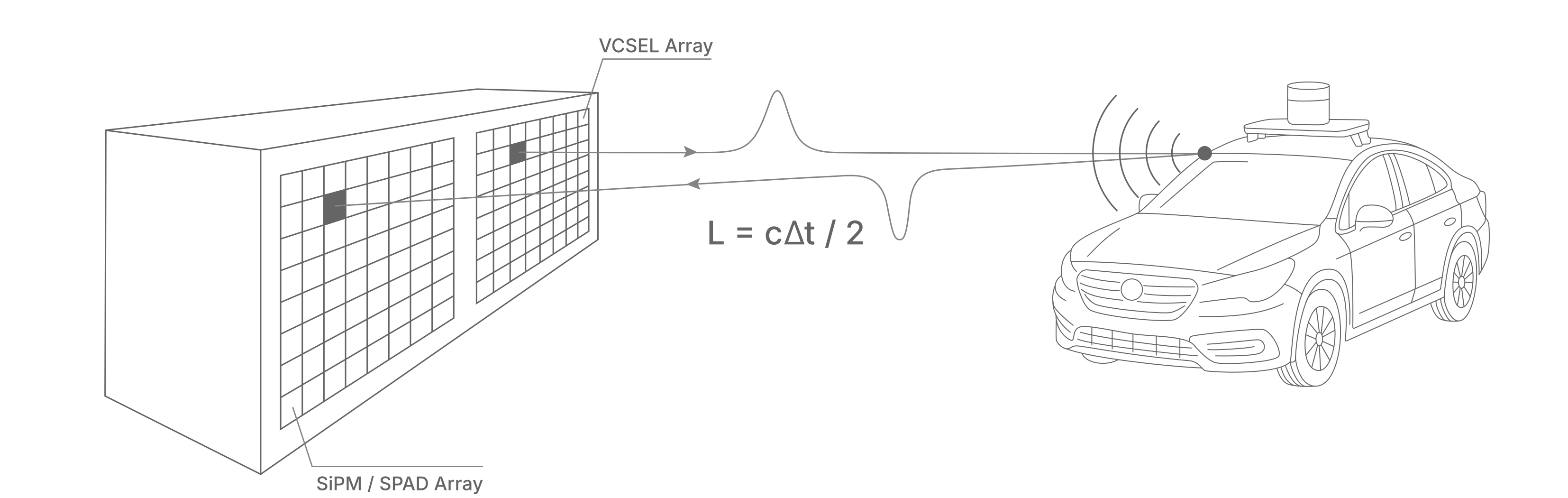
3D LiDAR Performance Comparison
Limited multi-element capability results in low spatial resolution
Limited dynamic range forces trade-offs between sensitivity, spatial resolution, and frame rate
High spatial resolution and wide dynamic range
About Us
«Our mission is clear: to make affordable long-range LiDAR a reality for safe, mass-market deployment of autonomous vehicles.»
We are a fabless startup based in Dubai that develops silicon photomultipliers using proprietary in-house HD-SiPM technology, fabricated at leading semiconductor foundries. Unlike conventional SiPM designs, our is completely novel.
We've focused on developing detectors that make 3D LiDAR systems compact, cost-effective, and long-range for autonomous vehicles and other pulsed sensing applications.
We've focused on developing detectors that make 3D LiDAR systems compact, cost-effective, and long-range for autonomous vehicles and other pulsed sensing applications.
Our team combines experienced specialists in semiconductor physics, device fabrication, and signal processing electronics, bringing decades of collective expertise in solid-state photodetectors.
The Avalantra roadmap begins with single-element detectors and linear arrays, progressing toward 2D SoC matrices with integrated analog-to-digital ASICs. Each step expands the performance and integration level of our technology.
The Avalantra roadmap begins with single-element detectors and linear arrays, progressing toward 2D SoC matrices with integrated analog-to-digital ASICs. Each step expands the performance and integration level of our technology.
FAQ
Our HD-SiPMs are intended solely for civilian use, with a focus on applications such as automotive LiDAR and other advanced pulsed sensing systems.
Can your photodetectors be purchased for military applications?
Yes. We are planning the development of a system-in-package together with a multi-channel ASIC that provides photodetector biasing, signal amplification, and digitization. For 2D HD-SiPM arrays, a 3D-stacked system-on-chip with integrated ASIC is under development.
Multi-element HD-SiPM arrays are rather difficult to integrate into LiDAR systems using discrete components. Will a packaged solution with an ASIC be available?
The Avalantra HD-SiPM Gen 0.1 is expected to be available by the end of 2026. We will be ready to supply small batches of photodetectors for evaluation, provide consulting on integration into end products, and assign one of our engineers to support testing in your laboratory.
When will your photodetectors be available for purchase, and how can they be tested?
The low probability of crosstalk and afterpulsing is achieved through an optimized gain of ~ 10⁴ in the Avalantra HD-SiPM, in contrast to conventional SiPMs / SPADs with gains of ~ 10⁵–10⁶. The reduced gain also lowers the power consumption and heat generation of the photodetector during operation.
The Avalantra HD-SiPM features a low probability of crosstalk and afterpulsing (< 1%). How are such characteristics achieved with a microcell pitch below 5 µm?
Unlike conventional SiPMs / SPADs, in the Avalantra HD-SiPM photoconversion occurs across the entire active area of the photodetector rather than in isolated cells. Photoelectrons are focused into the nearest non-planar amplification microchannel, where they are multiplied through avalanche impact ionization with a gain of ~ 10⁴. There are no dead areas insensitive to light between the amplification microchannels (microcells).
How does your design differ from conventional SiPMs / SPADs?
The primary factor limiting the threshold sensitivity of SiPMs in outdoor LiDAR applications is solar background illumination, which can reach up to 100 klux. In this case, a dark count rate of even 100 kcps per microcell is negligible compared to the noise from background illumination.
The Avalantra HD-SiPM has a relatively high dark count rate of about 100 kcps per microcell. How is high threshold sensitivity maintained for LiDAR applications?